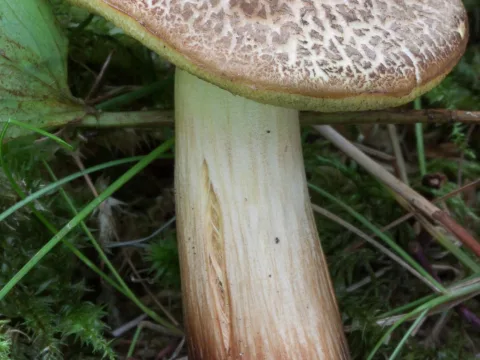
- Cap convex to expanded, velvety, yellow-brown to dark brown.
- Tubes yellow when young, becoming yellow-green with age, with angular pores, not bruising blue or only weakly so.
- Stem yellow-brown to reddish-brown, often with reticulation that is most clearly visible near the top.
- Flesh yellowish-white, with mild taste and smell.
Xerocomoid boletes
Suede Bolete aggregate
Xerocomus subtomentosus s.lat.
NA
Not applicable
Edible
4 images

Characteristics
Ecology
Common in deciduous and coniferous forest throughout the Nordic region.
Notes
The stem is often woody in consistency and should be removed before cooking. There are more similar boletes, but none of them are poisonous.
Xerocomus subtomentosus s. lat. is a complex with several species that can be difficult to separate, including Xerocomus ferrugineus and Xerocomus chrysonema.
Xerocomus subtomentosus s. lat. is a complex with several species that can be difficult to separate, including Xerocomus ferrugineus and Xerocomus chrysonema.
Similar species
Hortiboletus rubellus has a red cap, rare.
Xerocomellus chrysenteron has a cracking cap and red colours in the cap cracks, edible.
Xerocomellus porosporus has a cracking cap without red colours in the cap flesh, edible.
Imleria badia has a dark brown cap and lacks reticulation on the stem, a good edible mushroom.
Xerocomellus chrysenteron has a cracking cap and red colours in the cap cracks, edible.
Xerocomellus porosporus has a cracking cap without red colours in the cap flesh, edible.
Imleria badia has a dark brown cap and lacks reticulation on the stem, a good edible mushroom.